Infrastructure Deficit
Africa requires approximately $170bn in annual infrastructure investment by 2030 — less than 40% is currently financed.
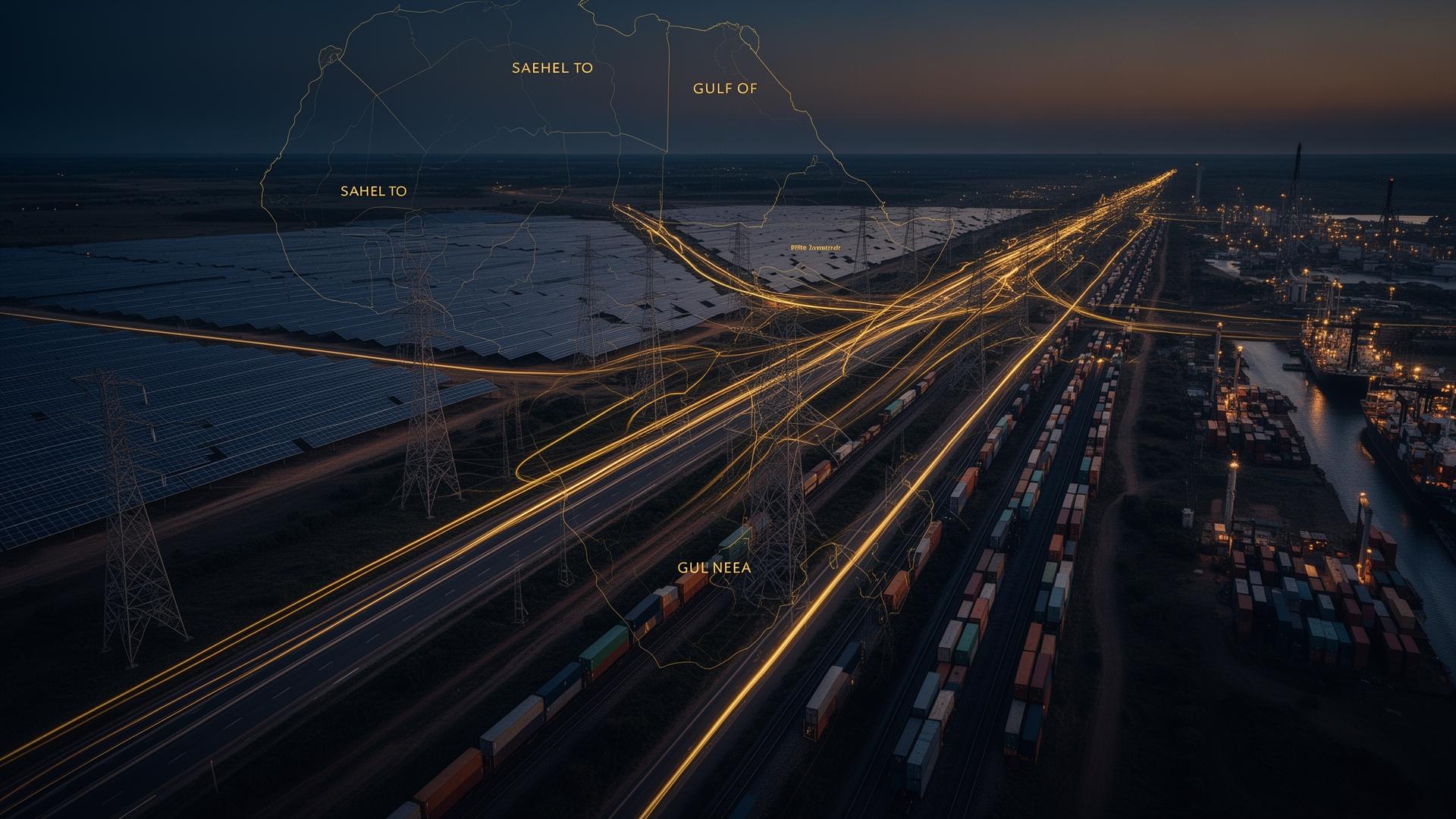
Infrastructure & Energy Division • CH Sahel Holding
Engineering the networks that will power Africa's twenty-first century growth.
Financing large-scale renewable, transport, and logistics corridors from the Sahel to the Gulf of Guinea.
2.4 GW
Structured Energy Capacity
3,200 km
Corridors Covered
28
Projects in Execution
$5.2B
Capital Catalysed
01 — Infrastructure & Energy
Infrastructure and energy represent the material foundation of Africa's economic transformation. CH Sahel structures and finances the assets that make industrialisation, mobility, and regional integration achievable.
Africa requires approximately $170bn in annual infrastructure investment by 2030 — less than 40% is currently financed.
The combined Sahel and West Africa population will double by 2050, demanding a wholesale transformation of energy and logistics networks.
Over 600 million Africans lack access to reliable electricity — energy is the primary productivity multiplier across every sector.
The Dakar–Lagos, Douala–N'Djamena, and Abidjan–Niamey axes are the structural backbone of continental industrial integration.
02 — Infrastructure & Energy
An active network of energy, logistics, and digital corridors connecting the Sahel to the Gulf of Guinea.
Sahel–Atlantic Corridor
Dakar — Bamako — Niamey — N'Djamena
Gulf of Guinea Corridor
Abidjan — Accra — Lagos — Douala
HV Energy Corridor
WAPP · CLSG · CEMAC Interconnect
Central Logistics Corridor
Douala — N'Djamena — Khartoum
Digital Backbone
Trans-Sahelian Fibre · WACS · 2Africa
03 — Infrastructure & Energy
Six strategic verticals underpin our infrastructure and energy investment thesis.
04 — Infrastructure & Energy
TWh · Sahel · West Africa · Central Africa
USD bn · 2030 horizon
USD bn · requirements vs. secured financing
USD bn · AfCFTA · 2035 horizon
05 — Infrastructure & Energy
African infrastructure represents one of the largest investment opportunities of the twenty-first century — a simultaneous convergence of five structural dynamics.
60% of Africa's population will be urban by 2050, placing unprecedented demand pressure on energy and utility networks.
Localisation of commodity processing and the emergence of integrated regional value chains.
The AfCFTA could drive continental trade flows from 14% to 52% of total exchanges by 2035.
African solar delivers some of the world's most competitive LCOEs — $30–45/MWh — underpinning the regional clean-power build-out.
Fibre coverage and data centre capacity are essential prerequisites for regional digital sovereignty.
06 — Infrastructure & Energy
The CHSahel AI platform powers every mandate — predictive models, scenario simulations, and real-time asset and corridor mapping.
Hourly demand models by regional grid node and 2030–2050 climate scenarios.
Corridor optimisation and 15-year multimodal flow modelling.
Asset geolocation, country risk scoring, and sector opportunity identification.
Climate, political, currency, and sovereign counterparty stress-testing.
Proprietary routing algorithms and optimal regional hub placement.
Macro-prospective models integrating energy pricing dynamics and AfCFTA integration pathways.
07 — Infrastructure & Energy
Measuring each project's tangible contribution to energy sovereignty, employment generation, and economic integration.
85,000+
Direct & Indirect Jobs
2.4 GW
Structured Energy Capacity
3,200 km
Corridor Kilometres
12M+
Populations Served
4.8 Mt/yr
Projected CO₂ Reduction
$5.2B
Capital Catalysed
Institutional Conviction
“Infrastructure is not merely physical assets.
It is the foundation of economic prosperity
and of regional sovereignty.”
CH Sahel Holding — Infrastructure & Energy Division
08 — Infrastructure & Energy
Engage our Infrastructure & Energy team to explore a mandate, co-financing arrangement, or sovereign partnership.